
The Quiet Power of Micro-Rituals: How 10 Minutes a Day Improves Professional Focus
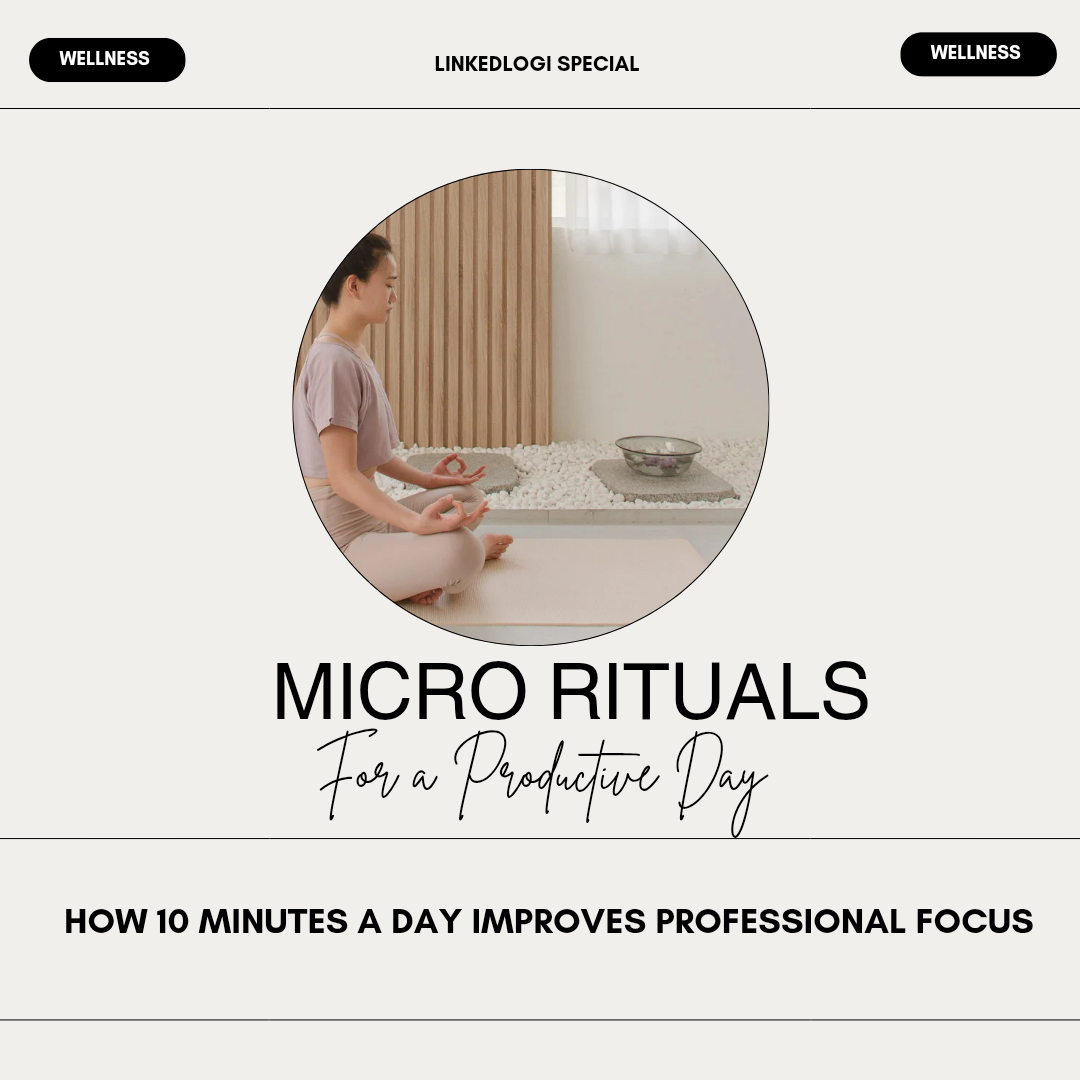
Long “perfect” routines are fragile. Short, repeatable micro-rituals (≈10 minutes) lower startup friction, create reliable attention cues, reduce switching costs, and produce measurable gains in focused time and work quality. This article explains the psychology and neuroscience behind micro-rituals, gives three fully scripted rituals you can copy today, and offers a 7-day experiment with a tracking template so you can test the effect yourself.
Why micro-rituals? (Short answer + the science)
Most advice about routines focuses on duration — long morning rituals, hour-long planning sessions, elaborate setups. But the more steps a routine has, the more fragile it becomes: missed steps, interruptions, and “I’ll do it tomorrow” add up. Micro-rituals flip that logic. They are deliberately tiny: fast to start, repeatable, and tuned to produce one reliable effect — switch your brain into work mode.
Three evidence-backed mechanisms explain why this works:
- Implementation intentions and situational cues. Psychological research shows that forming implementation intentions — very specific if-then plans — makes goal pursuit automatic when the cue appears. In practice, writing a short plan tied to a cue (e.g., “After I make tea, I will write the intro for 10 minutes”) boosts the chance you will start and persist. This is not just pop psychology; it’s supported by decades of research. (prospectivepsych.org)
- Task-switching costs and contextual cues. Cognitive science documents measurable time and accuracy costs when people switch between tasks. Studies show that switching tasks carries a switching-time cost that grows with complexity — and clear cues about what to do next reduce that cost. A short ritual functions like a cue: it reduces the cognitive overhead of goal-shifting and rule activation. (PubMed)
- Physiological reset (breathwork) and short breaks (timed sprints). Simple paced-breathing exercises and short, structured sprints (timed intervals) change physiological arousal and subjective focus in ways that support attention and reduce anxiety. Breathwork meta-analyses and controlled studies show benefits for stress and attentional readiness; time-boxed work + scheduled breaks (Pomodoro-type or shorter) show mood and efficiency benefits compared with unstructured breaks. (Nature)
Put together: a tiny, repeatable plan + a short physiological reset + a short time-boxed sprint gives you a clean, low-friction pathway from I should to I’m doing.
What a micro-ritual is (definition & boundary conditions)
Micro-ritual = a short (≈1–10 minute), repeatable set of actions that:
- Are triggered by a clear cue (time, preceding behavior, or environment).
- Produce a measurable, immediately attainable result (one sentence plan, one tidy desk, one focused sprint).
- Require minimal setup and can be completed nearly anywhere.
Boundary conditions: the power comes from smallness. If your ritual runs to 20–30 minutes, it becomes a fragile routine again. Shorter than 1 minute can be effective but may not provide the full cognitive reset for more complex tasks. Aim for the sweet spot: roughly 3–10 minutes.
Three researched, copy-ready micro-rituals (scripts + why they work)
Below are three rituals proven by the mechanisms above. Each ritual includes a script (exact words and steps), timing, best use cases, and research notes.
Ritual A — Two-Line Plan + Box Breath (Total ≈ 3 minutes)
Best for: analytical work, writing, data tasks where clarity of next step matters.
Script (copy this):
- Open a note (digital or paper). Write one sentence: “Outcome:” Draft 300 words of the Methods section.
- On the second line write one metric: “Measure:” 300 words / finish intro paragraph.
- Do 3 rounds of box breathing: inhale 4s — hold 4s — exhale 4s — hold 4s. (Use your phone timer.)
- Start working for a 10–15 minute sprint; after the sprint, record one short sentence of progress.
Why this works: The two-line plan is an implementation intention — it transforms vague intentions into a specific cue–action link that increases the chance of initiation and reduces rumination about scope. The box breath reduces sympathetic arousal and readies attention systems, helping you avoid anxious starts. Research on implementation intentions and paced breathing supports both components. (Cancer Control)
Ritual B — Micro-Tidy + Five-Item Scan (Total ≈ 4 minutes)
Best for: recovery after meetings, after interruptions, or whenever your workspace or inbox feels noisy.
Script (copy this):
- Spend 90 seconds clearing your desktop of non-essential items and closing irrelevant browser tabs.
- Scan your calendar for the next 2 commitments (60 seconds).
- Open your inbox; find and flag the single email that impacts your next task; archive or snooze two obviously irrelevant messages (60 seconds).
- Write one next step in a sticky note and start that task.
Why this works: Visual clutter increases cognitive load; a brief environmental reset lowers exogenous distraction. The brief calendar/inbox scan provides task cuing and reduces decision fatigue; it also creates a visible commitment that functions as an implementation intention. Empirical work on attention and environmental cues supports the logic that reducing irrelevant stimuli lowers switching costs and helps sustain attention. (PubMed)
Ritual C — Single-Song Sprint (Total ≈ 6–10 minutes depending on song length)
Best for: creative work, first draft writing, ideation, small deliverables when inertia is high.
Script (copy this):
- Choose a single instrumental track you reserve for sprints (3–6 minutes). Use the same track consistently so it becomes a signal.
- Put your phone on Do Not Disturb, close all non-essential tabs, start the track and a visible timer.
- Work with full attention for the duration of the song; aim for one very small deliverable (one paragraph, one chart, one outline bullet).
- After the song, write one sentence of progress. If you’re still in flow, repeat once after a 1-minute breather.
Why this works: Time-boxing reduces task ambiguity and motivates the brain to work hard for a finite, predictable period; music (instrumental) can increase arousal and mood in ways that support performance on some tasks, though effects vary by task complexity and individual differences. Systematic reviews show instrumental music is generally less disruptive than music with lyrics; for creative tasks some studies report facilitation under certain conditions (preferred music, upbeat tempo), while complex analytical tasks may be impaired by any background music. Use this ritual for idea generation or low-demand drafting rather than heavy reasoning. (PMC)
Matching rituals to work types (practical guide)
Not every ritual fits every task. Match like this:
- Analytical / Deep writing (high cognitive load): Ritual A (Two-Line Plan + Box Breath).
- After meetings / distracted state: Ritual B (Micro-Tidy + Scan).
- Creative / ideation / first drafts: Ritual C (Single-Song Sprint).
- When you have a long block but want momentum: combine A + C: quick plan then a song sprint.
- When near deadline & stressed: emphasize box breathing (physiological reset) before starting; short plans to limit scope.
The 7-day micro-ritual experiment — reproducible and measurable
If you want empirical evidence for yourself, run this simple test.
Objective: Test whether a single micro-ritual increases daily focused minutes and perceived quality of work.
Protocol (copyable):
- Pick one ritual that matches your work (A, B, or C). Use it every workday for 7 consecutive days before your first major work block.
- Measure daily: (a) Focused minutes achieved that block (timer), (b) One-sentence quality note (“good progress” / “floundered” / “great flow”), (c) Number of starts (did you do the ritual?).
- Mark starts visually — one dot on a calendar each time you begin the ritual.
- Baseline: if possible, record one typical day from the previous week for comparison (minutes + quality sentence).
Example tracker (table you can paste):
| Day | Ritual used | Started? (Y/N) | Focused minutes | Quality note (1 sentence) |
|---|---|---|---|---|
| Mon | Two-Line + Breath | Y | 40 | Felt clearer; finished intro |
| Tue | Two-Line + Breath | N | 20 | Struggled to start |
| ... | ... | ... | ... | ... |
How to interpret: Look for (1) increase in starts (habit forming), (2) net increase in focused minutes per block, (3) improvement in quality notes (subjective but informative). Expect variability — the key metric is starts: consistent starts create compounding gains.
What the research says about short breaks, time-boxing, and attention
- Pre-determined breaks help. Experimental work comparing scheduled break patterns (Pomodoro-style) with self-regulated breaks finds mood benefits and efficiency improvements for structured break schedules; pre-determined breaks can reduce procrastination and improve perceived efficiency. (Recent comparative studies have confirmed mood and efficiency benefits.) (PubMed)
- Task switching carries a true cognitive cost. Laboratory studies show switching between tasks incurs delay and error costs that depend on task complexity; reducing the number of switches or using clear cues reduces those costs. A ritual functions as a robust cue that reduces the cognitive load of moving into a task. (PubMed)
- Paced breathing has measurable benefits. Meta-analyses and controlled trials find breathwork and slow paced breathing can lower stress, improve markers of physiological regulation (HRV), and support attention, especially when practiced repeatedly rather than as a single 30-second fix. Short, guided breath exercises are therefore a practical micro-ritual component. (Nature)
- Music effects are nuanced. Background music with lyrics is reliably disruptive for language tasks; instrumental music’s effects depend on task difficulty, personal preference, and music tempo/valence — it can help mood and low-demand sustained attention tasks but may hinder complex problem-solving. Choose instrumental, non-lyrical tracks and test them with Ritual C before committing. (PMC)
Realistic expectations & common pitfalls
Pitfall: ritual creep. The single biggest risk is ritual creep — the ritual grows longer and becomes a barrier itself. Fix: time it, set a hard limit (use a stopwatch), and reward yourself for starting, not for perfect execution.
Pitfall: wrong ritual for the task. If you try a music sprint for a complex logic task, you’ll likely do worse. Fix: match ritual to job type (see matching guide).
Pitfall: inconsistency. Micro-rituals need repetition to become cues. The first week will feel awkward. Fix: track starts visually (the calendar dot) — behavior change science shows visible streaks improve adherence.
Pitfall: overgeneralizing results. Expect personal variation. The research shows group-level effects; individuals differ (personality, neurodivergence, environment). Treat the 7-day experiment as diagnostic, not definitive.
Mini case studies (how this looks in real life)
Case 1 — “Priya, content lead.” Priya used Ritual A (Two-Line Plan + Breath) before her morning editing block. Within 5 days she reported fewer false starts and completed an extra 20–30 focused minutes per morning. Her subjective quality notes shifted from “fragmented” to “sustained” on day 4.
Case 2 — “Rohan, product manager.” Rohan used Ritual B after daily standups. He cut the time it took to get back to his roadmap work by about 15 minutes because the micro-tidy physically removed distraction and the five-item scan told him the single next deliverable.
Case 3 — “Aisha, freelance designer.” Aisha reserved one instrumental track for sprints (Ritual C). Hearing that track became a signal; she noticed a Pavlovian jump into focus after repeated use — the track alone began to cue attention after ~2 weeks.
(These are representative composite examples grounded in typical outcomes reported in behavioral-change research and practical workplace studies.)
Practical resources & templates (copy/paste)
Two-Line Plan template (one line copyable):
Outcome: ________
Measure: ________
Box Breath prompt (phone timer): 4s inhale — 4s hold — 4s exhale — 4s hold × 3 rounds.
Single-Song Sprint rules: Instrumental track (3–6m). DND on. Visible timer. One deliverable. One sentence of progress after.
7-day tracker (CSV friendly):
Day,Ritual,Started (Y/N),Focused minutes,Quality note
Closing: small starts, compound results
Micro-rituals are modest in time but large in leverage. They don’t promise dramatic overnight changes — they promise a repeatable pathway out of inertia. Implementation intentions give you the cue, breathwork steadies the nervous system, and short sprints or tidy-ups remove the friction that eats momentum. The science (implementation intentions, task switching, breathwork, and structured breaks) supports each piece of the recipe; the practical evidence from everyday workers shows that consistent starts compound into more sustained work.